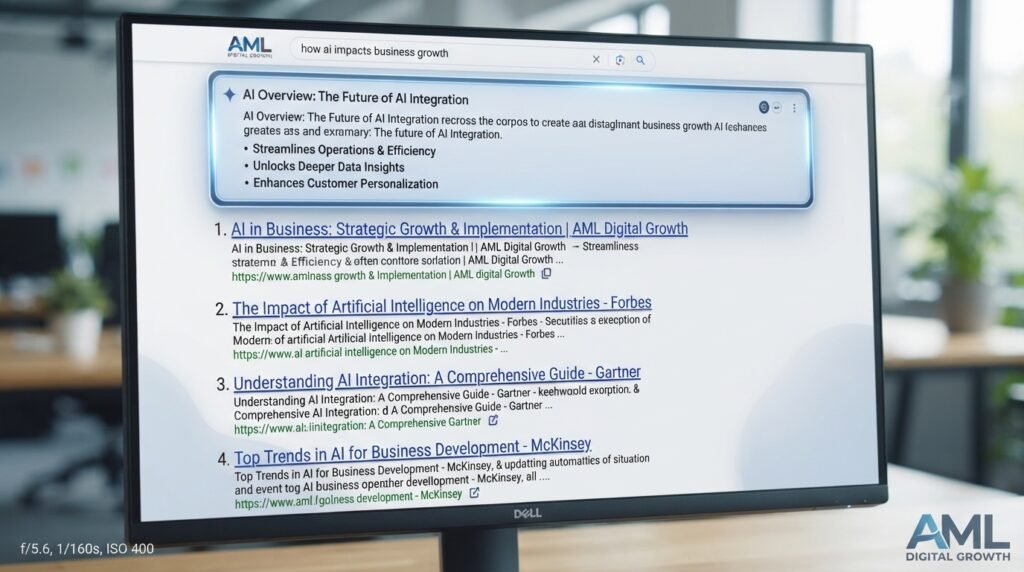
Have you noticed that search engines now answer some questions before you click a link? Pew Research Center’s March 2025 study found that 18% of Google searches produced an AI summary. These AI-generated answers now sit beside the old list of links.
Search results now come in three kinds. Search engine optimization (SEO) aims for a page that ranks as a blue link. Answer engine optimization (AEO) aims for your sentence to become the single direct answer. Generative engine optimization (GEO) aims for an AI system to name your page as a source.
An answer engine is a search tool or assistant that returns a direct answer to a question instead of a list of links. Generative engines work differently. They blend several sources into one written response.
These three targets do not replace each other. They work together and often rely on the same good content. Ranking, citation and direct answers now compete for the same attention on one results page.
Key Takeaways
- SEO earns rankings, AEO earns direct answers, and GEO earns citations in AI responses.
- An answer engine returns one direct answer instead of a list of links.
- AI summaries appeared in 18% of Google searches in March 2025.
- All three disciplines rely on content that is indexed, clear and trustworthy.
- Decide which result type matters most for your traffic before you act.
Why Search Results Look Different Now
When a Google results page shows an AI summary, users clicked a traditional link in 8% of visits. Without a summary, that share rose to 15%. So SEO is evolving, not dead, in 2026, because classic links still earn clicks when no summary shows.
Clicks fall when an AI summary appears, so ranking alone no longer tells the whole story.
The drop is sharper inside the summary itself. Only 1% of visits included a click on a link inside the summary. Sessions also ended after 26% of pages with a summary, compared with 16% of pages without one.
Many people now run these searches. In a survey, 58% of U.S. adults ran at least one search that produced an AI summary. Search results still matter, and AI summaries sit inside them. AI referral traffic from AI platforms is still small next to search. BrightEdge reported that ChatGPT held 95.1% of AI referral traffic in August 2026. Measure users clicks, not only rankings. Track both clicks and visibility, because a result that earns no click can still shape a decision.
SEO vs GEO vs AEO: What Each One Targets
SEO asks whether a page ranks, AEO asks whether a sentence gets read as the answer, and GEO asks whether an AI system names the source. Each question points to a different result type. Each result type needs its own kind of optimization.
Search engine optimization (SEO) targets ranked blue links, the list of pages Google orders for a query. Answer engine optimization (AEO) targets the single direct answer that a featured snippet or voice assistant reads aloud. Generative engine optimization (GEO) targets citations inside a synthesized AI response, where the AI writes one answer from several sources.
One Question, Three Targets
Take the question, “What is the best way to descale a coffee maker?” SEO aims for a page that ranks high in the list. AEO aims for a short answer, such as “Run equal parts white vinegar and water through the machine, then rinse it twice.” GEO aims for an AI system to name your page as the source of its steps.
All three targets use the same underlying content quality. A page that is hard to read rarely wins any of them. Decide which of the three targets matters most for your traffic before you spend budget on any of them.
AEO vs GEO: The Core Differences
AEO wins when one answer is lifted word for word, while GEO wins when the AI blends your content into several sources. The goal is the main difference. AEO wants your exact sentence shown. GEO wants your page credited inside a longer answer.

Answer engines include featured snippets, voice assistants and Google AI Overviews. Generative engines, such as ChatGPT, Perplexity and Google AI Mode, build a new answer from several sources.
| Feature | AEO | GEO |
|---|---|---|
| Goal | One direct answer | Citation in a blended answer |
| Typical platforms | Featured snippets, Google AI Overviews | ChatGPT, Perplexity, Google AI Mode |
| Answer length | Usually 40-60 words for the direct answer | Several sources combined |
| Success sign | Your sentence is shown word for word | Your page is named as a source |
AEO and GEO are not opposites. One piece of content can serve both. A recipe page might open with a 50-word answer to “how long to cook rice,” which a featured snippet can lift. Lower on the page, the same recipe can share test results and sources that an AI tool can cite.
Write the direct answer first, then add the evidence an AI system needs before it cites you.
Is AEO Replacing SEO?
No, AEO does not replace SEO, because the answer shown in a snippet usually comes from a page that already ranks. Is SEO replaced by AEO? No, the two depend on each other. The difference between AEO and SEO is how each one is measured.
SEO is measured by organic rankings, the positions a page holds in the list of links. AEO is measured by answer appearances, the times your sentence is shown as the answer. A featured snippet typically appears above the first ranked result, and many people call it an answer box.
Google AI Overviews also tend to draw from pages that already rank well. A guide on cleaning cast iron that ranks first can earn the featured snippet and still collect clicks from its blue link. The ranking makes the answer possible, and the answer formatting makes it easy to lift.
Keep ranking work in place and add answer formatting on top of it.
Using All Three Together in Practice
Start with indexing, because a page that cannot appear in search cannot be cited either. Doing AEO and GEO well means one routine: index the page, answer the question clearly, and add evidence. Digital marketing teams can add these steps to work they already do.

Google’s guidance says a page must be indexed and eligible to appear with a snippet to count as a supporting link in AI Overviews or AI Mode. No special schema or AI text file is required. Follow these five steps for each priority page:
- Confirm the page is indexed in Google Search Console.
- Check that no setting blocks the page from showing a snippet.
- Use a clear content structure with a direct answer near the top.
- Add evidence below the answer, such as test results or named sources.
- Check whether AI tools such as Perplexity or ChatGPT cite the page.
A guide on sourdough starter care can follow this routine. It ranks for the main query, earns a featured snippet with a 50-word opening answer, and gets cited by an AI tool for its feeding schedule. Review one priority page each month for ranking, snippet and citation status.
AEO vs GEO Examples in Everyday Search
A question that starts with what or why is the query type most likely to return an AI summary. The AEO vs GEO examples below show how the question type decides which one matters more. Answer engines handle short factual questions well, while longer questions often get blended answers.
In Pew Research Center’s study, questions beginning with who, what, when or why produced an AI summary in 60% of cases. Queries of ten words or more produced one in 53% of cases. One- or two-word queries produced one in only 8% of cases.
Three Everyday Queries Compared
“What soil pH do tomatoes like?” is an AEO query, where one clear sentence can win. “Which water filter works best in a small kitchen, and why?” is a GEO query, where Perplexity may blend several reviews into one answer. “Best running shoes for flat feet” is a comparison, where an answer may name brands such as Brooks or ASICS as options.
Long conversational questions trigger summaries more often because they carry more detail. The search system needs more context to answer them well. A blended answer can use that context, so it gives more value than a single line.
Write for the exact question a buyer types, not only the keyword.
Measuring Results Across SEO, GEO and AEO
Google Search Console reports generative AI impressions for every site, but it does not show the prompts behind them. Search visibility means how often your pages appear for a query. Each discipline needs its own measure to show results.

| Discipline | Main metric | Where to check |
|---|---|---|
| SEO | Ranking position for target queries | Search Console Performance report |
| AEO | Featured snippet appearances | Rank tracking tools and Search Console |
| GEO | AI citations in answers | Manual checks in ChatGPT and Perplexity |
| GEO | AI referral traffic | Analytics referral reports |
By August 31, 2026, the generative AI performance report reached all websites worldwide. It shows impressions, pages, countries, devices and dates. It does not include Search Labs experiments.
SEO tools can track rankings well, but citations usually need manual checks. Pair search data with AI referral traffic before you judge a campaign.
What Google Requires for AI Features
A page appears as a supporting link in AI Overviews only when it is indexed and eligible for a snippet. Google sets this rule for the AI features it shows in search. Three conditions must all be met for a supporting link:
- The page is indexed by Google.
- The page is eligible to appear with a snippet, so no nosnippet setting blocks it.
- Googlebot can crawl the page, so robots.txt does not block it.
Schema Is Helpful, Not Required
Google states that no special schema.org data, AI text file or extra optimization is required. Structured data still helps machines read the page, so it is worth adding. It is a helper, not a condition for a supporting link.
Some sites add extra AI files or special markup and expect faster results. Those steps do not replace indexing. Confirm indexing before you spend time on any AI-specific format.
Choosing Where to Put Your Budget
A site that earns most of its traffic from transactional queries should keep SEO as the first priority. Buy-now searches send people who are ready to act. Ranking pages for those searches usually brings the fastest return.

| Site type | Main query type | Priority discipline |
|---|---|---|
| Online store | Transactional, buy-now queries | SEO |
| Recipe or health blog | Informational questions | AEO first |
| Research publisher or brand | Comparisons and expert questions | GEO |
Google Search Console shows AI Overviews data in the Performance report under the Web search type. AI Mode is included there too. A site with heavy informational queries benefits from AEO first, because short direct answers are what featured snippets and AI Overviews lift.
Most sites split effort across all three. A clear SEO strategy starts with the query types your visitors send. Reassess the split every quarter as the share of AI-driven clicks changes.
Common Mistakes When Mixing the Three
The most common error is writing a thin page and then expecting an AI system to cite it. Stuffing a page with repeated keywords gives an AI system nothing it can use. Fix this by adding original data and credible sources, such as your own test results.
Thin pages rarely earn citations, so add original data before you add keywords.
Answers buried under long introductions are hard to lift. A reader or a featured snippet has to dig for the point. Fix this by placing a direct answer of 40-60 words at the top of each section.

Pages blocked from crawlers never reach the index, so no answer can be lifted or cited. Fix this by checking robots.txt rules and the indexing report in Search Console. Fix indexing and structure first, because they limit all three disciplines.
Conclusion
The three disciplines share one foundation: content a search system can find, read and trust. SEO helps pages get found and ranked. AEO helps a short answer get lifted, and GEO helps an AI system cite the page. Each one is a layer of the same system, not a rival.
A page that is indexed and clearly structured can serve all three. A thin page serves none of them well. Clear answers and real evidence give each layer something to work with.
Start with one priority page this week and check its indexing, its direct answer and its citations.